Sexual evolution
The Selfish GeneThe book’s account of the evolution of sex reframes an apparent evolutionary paradox: sexual reproduction gives each parent only half of a child’s genes, yet genes that promote sex and genetic mixing can still prosper. Its explanation shifts attention from what benefits an individual organism to what enables particular genes to persist across generations, while openly leaving the ultimate origin of sex unresolved.
The genetic basis of the puzzle
Modern organisms are built by many thousands of genes acting in intricate collaboration. Genes influence different parts of the body, their effects depend on other genes and the environment, and some regulate clusters of other genes. An organism is therefore not the work of any single gene but a temporary vehicle assembled through an interdependent developmental process.
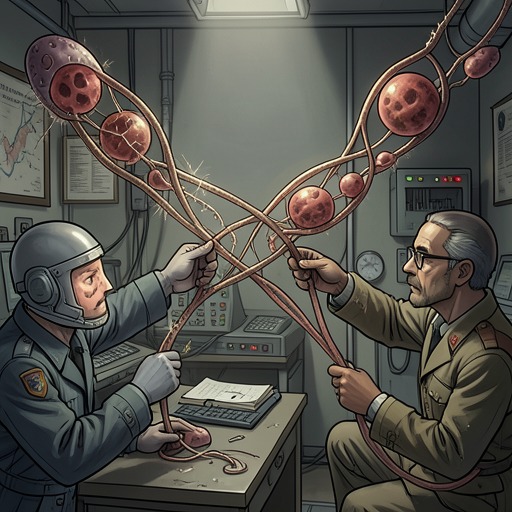
Sexual reproduction makes that vehicle temporary in a second sense: it mixes and shuffles genes. During the formation of sperm or eggs, corresponding pieces of chromosomes inherited from an individual’s parents can detach and exchange places. This crossing-over produces chromosomes that are mosaics of genetic material from different ancestral lines, rather than intact copies of a chromosome from one parent.
The boundaries of a gene do not necessarily protect it from this exchange. Even if a gene is defined as a sequence coding for one protein, crossing-over can split that sequence as well as occur between sequences. The book therefore uses a more flexible definition: a gene is a portion of chromosomal material capable of lasting through enough generations to act as a unit of natural selection. On this account, an individual’s particular genetic combination is short-lived, while the genes in it may pass through many successive bodies.
Why sex looks inefficient
From the perspective of an individual, sex appears to be an inefficient means of propagating genes. Each offspring receives only half of that individual's genes, with the other half supplied by a sexual partner. A female reproducing without sex, like a greenfly that can produce offspring without a father, could instead pass on all her genes in each offspring.
This apparent disadvantage has encouraged explanations based on benefits to groups. One such proposed advantage is that sex can bring advantageous mutations that arose separately in different individuals together in one individual. But the book argues that the paradox arises partly from asking the wrong question: the relevant unit need not be the individual organism, considered as a whole, but the gene whose copies compete across generations.
The contrast is between the individual as a coherent organism and the individual as a temporary confederation of genes. From the first viewpoint, losing half of one’s genetic contribution to each offspring looks costly. From the second, the individual’s overall genetic efficiency is not decisive; what matters is whether a gene that influences reproduction leaves more copies of itself in the gene pool than rival forms do.
Genes that promote genetic mixing
The proposed explanation treats sexuality as a characteristic that can be influenced by genes, much like a difference in eye colour. A gene that promotes sexual reproduction need not benefit every other gene in the organism. It need only gain an advantage for itself by influencing the reproductive system, allowing it to spread even if the organism-wide accounting of genetic contribution makes sex appear inefficient.
The same reasoning applies to crossing-over. The book also invokes mutator genes, which alter the rates at which other genes are copied. A copying error disadvantages the gene that is miscopied, but a gene that causes more errors could still spread if the resulting change benefits that mutator gene. In each case, the effect on the organism or on other genes does not by itself explain whether the gene responsible for the process will persist.
This account makes the unusual character of sex less mysterious from a gene-centered perspective: sexual reproduction and recombination need not be efficient strategies for an individual considered as a whole. They can exist because genes that favor them gain an advantage in transmission. The explanation is a selection argument, not a claim that genes consciously plan or that every gene benefits from sex.
Limits and implications
The argument does not claim to provide a complete explanation for how sex first arose. The book calls the question extremely difficult and declines to develop the sophisticated mathematical reasoning often used to address it. It also recognizes a possible circularity: the reasoning that makes the gene a fundamental unit of selection relies on sex and crossing-over, even as it uses gene-level selection to explain those processes. The author says there may be ways out of the circularity but does not pursue them here.
The existence of sex and crossing-over is thus an acknowledged premise as well as part of the phenomenon being explained. Given that premise, the resulting genetic shuffling allows a small, sufficiently persistent genetic unit to be treated as a relatively independent agent of evolution, despite the close cooperation of genes in development. The force of the argument lies in this change of scale: the apparent wastefulness of sex for the individual does not settle whether it can benefit the genes that help bring it about.